
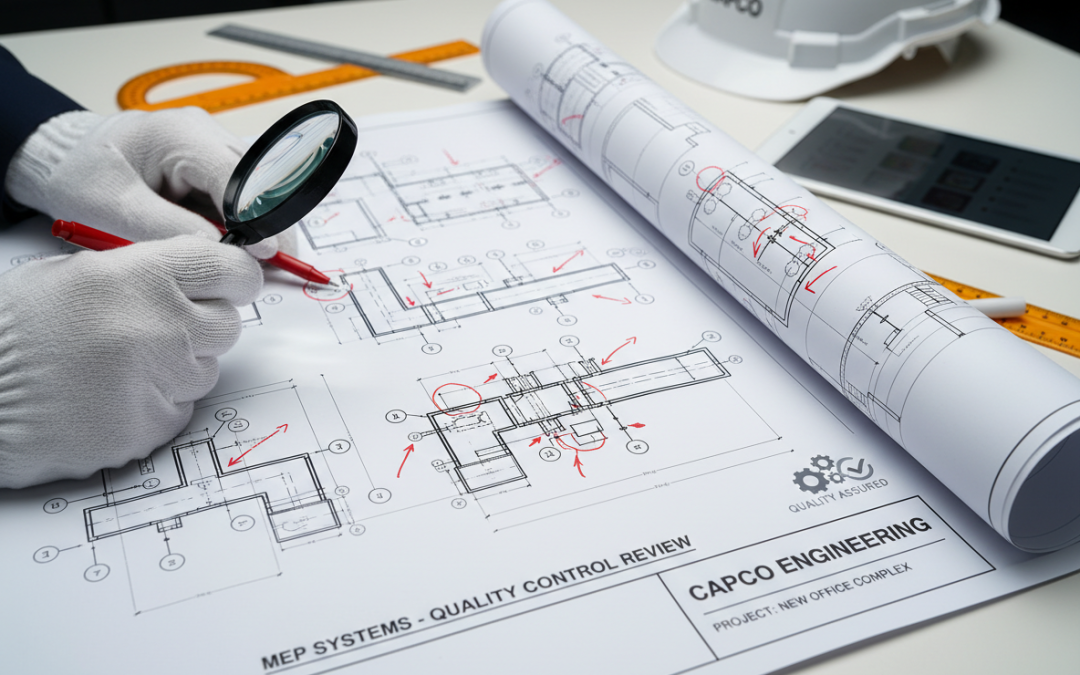
On large commercial and industrial projects, risk doesn’t usually come from one big mistake — it comes from small gaps that compound over time. Unclear drawings, missing coordination, or overlooked code requirements can quickly turn into RFIs, delays, change orders, and liability exposure for contractors.
This is where quality-controlled MEP drawings make a real difference.
Liability Often Starts at the Design Stage
Many construction issues that lead to claims or disputes can be traced back to design documents. When MEP drawings are rushed or poorly coordinated, contractors may be forced to make assumptions in the field — and those assumptions carry risk.
Common design-related liability issues include:
- Conflicting system layouts between trades
- Incomplete or unclear documentation
- Equipment that doesn’t fit the space as shown
- Code issues discovered during inspections
- Rework caused by late design changes
Even when contractors execute the work correctly, unclear drawings can still create exposure.
What Quality Control Means in MEP Design
Quality control in MEP engineering goes beyond a basic review. It’s a deliberate process that ensures drawings are:
- Code-compliant for the specific jurisdiction
- Coordinated across mechanical, electrical, plumbing, and architectural plans
- Clear and constructible for field installation
- Consistent in schedules, notes, and system layouts
This level of review helps catch issues early — before they reach the jobsite.
Fewer RFIs, Fewer Disputes
One of the clearest benefits of quality-controlled MEP drawings is a reduction in RFIs. When drawings are clear and coordinated:
- Contractors spend less time seeking clarification
- Field crews can install systems with confidence
- Project schedules stay intact
Fewer RFIs mean fewer opportunities for misunderstandings that can lead to disputes or claims.
Change Orders Are a Major Source of Risk
Change orders are often where liability exposure grows. When changes result from incomplete or conflicting design documents, responsibility can become unclear.
Quality-controlled MEP drawings help reduce change orders by:
- Identifying conflicts before construction begins
- Providing accurate equipment locations and requirements
- Supporting proper sequencing of trades
When changes are minimized, contractors maintain better cost control and reduce risk.
Code Compliance Protects Everyone
Inspections are a critical checkpoint for any project. MEP designs that don’t fully account for local codes can trigger failed inspections, rework, and delays — all of which increase liability.
In regions like Texas, Oklahoma, and New Mexico, code interpretations and permitting expectations can vary by jurisdiction. MEP drawings that are reviewed with local requirements in mind help projects pass inspections more smoothly and reduce exposure for the construction team.
Clear Drawings Support Safer Jobsites
Clarity isn’t just about efficiency — it’s also about safety. When installers clearly understand system layouts and requirements, there is less room for error. Well-documented MEP plans support safer installations and more predictable outcomes in the field.
How Capco Engineering Helps Reduce Risk
At Capco Engineering, quality control is built into our process. Our MEP drawings are developed with a focus on:
- Clear, coordinated system layouts
- Thorough internal reviews
- Equipment recommendations that align with real-world installation
- Permit-ready documentation
This approach helps contractors build with confidence, reduces unnecessary exposure, and supports smoother project delivery.
📍 Serving Texas, Oklahoma, and New Mexico
📐 Experience with commercial, industrial, and large-scale projects
🔧 MEP designs that prioritize clarity, coordination, and accountability
When MEP drawings are done right, everyone benefits — especially the construction team. If you’re looking for an MEP partner that understands the importance of quality and risk reduction, Capco Engineering is ready to support your next project.